
1.Why Prioritization is the Real Productivity Secret
Most people think productivity means doing more. But true productivity means doing what truly matters — and doing it well.
The problem? Our to-do lists are overflowing with urgent tasks that feel important but don’t move us closer to our long-term goals.
That’s where the Eisenhower Matrix comes in — a simple but powerful tool named after U.S. President Dwight D. Eisenhower, who once said:
“What is important is seldom urgent, and what is urgent is seldom important.”
At Skillvator, I’ve seen this matrix completely transform how professionals and entrepreneurs manage their time, energy, and focus.
By the end of this guide, you’ll know exactly how to distinguish between “urgent” and “important” — and how to prioritize tasks that create lasting impact.
2. What is the Eisenhower Matrix?
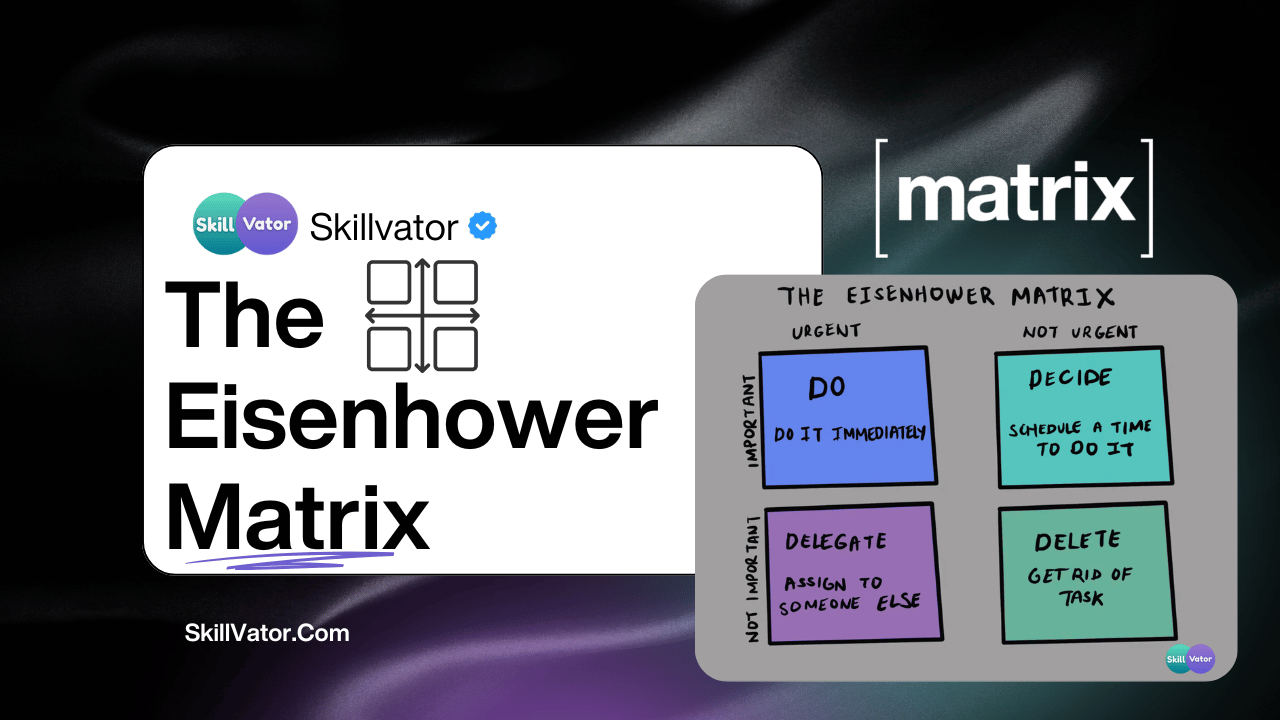
The Eisenhower Matrix, also known as the Urgent-Important Matrix, is a decision-making framework that helps you prioritize tasks based on two dimensions:
-
Urgency – how soon something demands your attention.
-
Importance – how much it contributes to your long-term goals or values.
You divide your tasks into four quadrants:
| Quadrant | Type | Action | Examples |
|---|---|---|---|
| I | Urgent & Important | Do it now | Crises, deadlines, client issues |
| II | Not Urgent but Important | Schedule it | Strategic planning, learning, exercise |
| III | Urgent but Not Important | Delegate it | Interruptions, some meetings, admin work |
| IV | Not Urgent & Not Important | Eliminate it | Scrolling social media, distractions |
This matrix isn’t just a time management trick — it’s a clarity framework that forces you to ask:
👉 “Does this task matter, or does it just feel urgent?”
3. The Psychology Behind the Matrix
Humans are naturally wired to respond to urgency. When something demands immediate attention — like an email ping or message notification — our brains release dopamine, making us feel productive even when we’re not moving closer to our goals.
The Eisenhower Matrix disrupts this bias. It helps you pause, analyze, and redirect focus toward importance over immediacy.
It’s about shifting from reactive mode to strategic mode — the true hallmark of high-performing professionals and leaders.
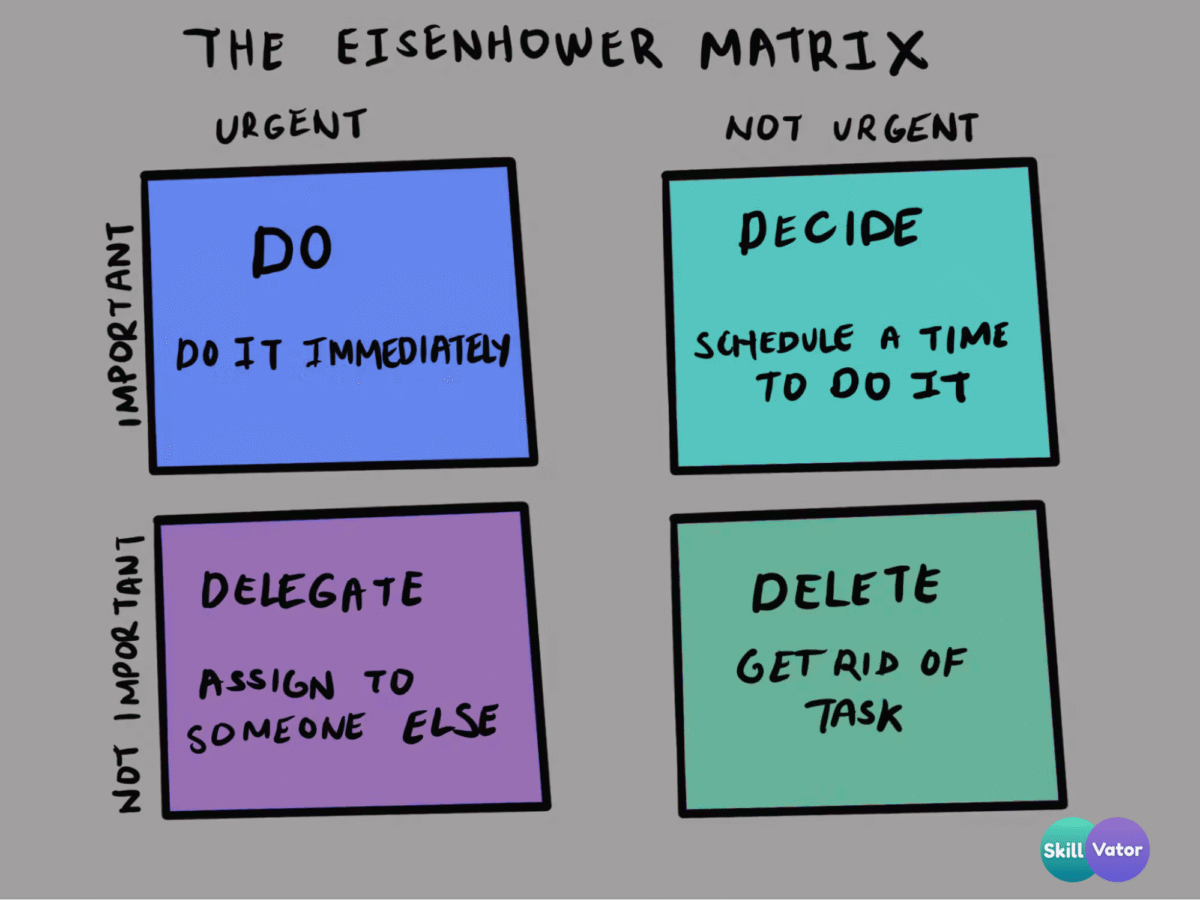
4. Deep Dive: The Four Quadrants Explained
Quadrant I: Do — Urgent and Important
These are must-do tasks. They have deadlines or serious consequences if ignored.
However, living entirely in this quadrant leads to stress and burnout.
Examples:
-
Meeting project deadlines
-
Handling emergencies
-
Fixing critical errors
-
Attending to client crises
Tips:
-
Set boundaries to reduce avoidable crises.
-
Use automation or planning to prevent repeat urgency.
Quadrant II: Plan — Not Urgent but Important
This is the sweet spot of personal and professional growth.
It includes activities that don’t demand immediate attention but are crucial for long-term success.
Examples:
-
Strategic planning and goal setting
-
Learning new skills (Skillvator-style growth!)
-
Networking and relationship building
-
Health, exercise, and self-care
Tips:
-
Schedule Quadrant II tasks on your calendar weekly.
-
Treat them like non-negotiable appointments.
Quadrant III: Delegate — Urgent but Not Important
These tasks feel urgent but don’t significantly impact your main goals.
Often, they’re someone else’s priority.
Examples:
-
Unnecessary meetings
-
Routine admin work
-
Requests that others can handle
Tips:
-
Ask, “Does this really need my attention?”
-
Use delegation tools or shared task management apps.
Quadrant IV: Delete — Not Urgent & Not Important
These are time-wasters. They don’t add value or help you grow.
While some relaxation is healthy, spending too much time here drains productivity.
Examples:
-
Endless social media scrolling
-
Gossip or complaining
-
Binge-watching without purpose
Tips:
-
Track your time to find hidden distractions.
-
Replace low-value habits with small, meaningful actions.
5. How to Apply the Eisenhower Matrix Step-by-Step
| Step | Action | Purpose |
|---|---|---|
| 1 | Write down all your current tasks | Create visibility |
| 2 | Label each task as urgent, important, both, or neither | Build awareness |
| 3 | Place tasks into the four quadrants | Visualize priorities |
| 4 | Focus first on Quadrant I, schedule Quadrant II | Action planning |
| 5 | Delegate or delete Quadrants III & IV | Remove distractions |
Bonus: Revisit your matrix weekly. Priorities shift — your system should too.
6. Real-Life Example: How the Matrix Changes Productivity
Let’s take two professionals — Amir, a project manager, and Leila, a small business owner.
Amir’s old to-do list:
-
Check emails
-
Client call
-
Review design
-
Plan next quarter goals
-
Fix a last-minute report error
Eisenhower Matrix applied:
-
Quadrant I: Fix last-minute report error
-
Quadrant II: Plan next quarter goals
-
Quadrant III: Client call (could be delegated)
-
Quadrant IV: Endless email checking (minimize)
Amir realized most of his time was going to urgent but low-value tasks. Within a month of using the matrix, he gained 4 extra productive hours per week.
Leila’s business application:
By categorizing daily operations, Leila delegated 40% of her tasks to her team and focused on marketing strategy (Quadrant II). Her revenue grew 15% in one quarter.
7. Integrating the Eisenhower Matrix with Other Productivity Systems
For even greater results, combine it with:
-
Time Blocking: Assign calendar blocks to each quadrant.
-
Pomodoro Technique: Focus on important tasks in 25-minute sprints.
-
SMART Goals: Ensure Quadrant II tasks are specific and measurable.
-
Digital Tools: Try Trello, Notion, or Todoist to visualize your matrix.
8. Answering Key Questions
Q1: How often should I update my Eisenhower Matrix?
Weekly reviews are ideal. Reassess your priorities every Friday or Sunday.
Q2: Can the Eisenhower Matrix work for teams?
Yes. Teams can use it in project meetings to align on priorities and delegation.
Q3: What’s the biggest mistake when using it?
Labeling everything as urgent. Learn to pause and evaluate impact, not just immediacy.
Q4: How is it different from simple to-do lists?
A to-do list shows everything you need to do; the Eisenhower Matrix shows what truly matters most.
9. Benefits of Using the Eisenhower Matrix
-
Reduces stress and overwhelm
-
Improves time allocation
-
Enhances focus and clarity
-
Boosts productivity without burnout
-
Strengthens decision-making discipline
In short: It’s not about working more hours — it’s about working on the right things.

The Eisenhower Matrix
10. Common Mistakes to Avoid
| Mistake | Impact | Correction |
|---|---|---|
| Treating all tasks as urgent | Leads to burnout | Ask: “What happens if I don’t do this today?” |
| Ignoring Quadrant II | No long-term progress | Schedule growth activities weekly |
| Poor delegation | Missed opportunities | Train your team or use automation |
| Overplanning | Delays action | Balance analysis with execution |
11. How the Matrix Builds Career and Business Momentum
At Skillvator, we emphasize strategic focus as a career skill.
By consistently applying the Eisenhower Matrix:
-
Employees gain clarity on what drives measurable impact.
-
Managers free up time for leadership and growth.
-
Entrepreneurs focus on scalable systems, not daily chaos.
This isn’t just time management — it’s skill-based decision management.
12. A 7-Day Eisenhower Challenge
Try this for one week:
-
Write every task you do daily.
-
Categorize each one into a quadrant.
-
Eliminate or delegate at least 2 Quadrant IV tasks daily.
-
Track how many hours you recover.
-
Reflect: Did you feel more focused, less reactive, and more fulfilled?
13. Conclusion: Focus is the New Freedom
Time is limited — attention is priceless.
The Eisenhower Matrix teaches you to invest both wisely.
When you focus on what’s important, not just urgent, you start shaping your career, business, and life intentionally — not reactively.
“The key is not to prioritize what’s on your schedule, but to schedule your priorities.” – Stephen Covey
At Skillvator, we believe mastering prioritization is a life skill that multiplies every other ability you have.
Start small, stay consistent, and remember: the most powerful growth begins when you focus on what truly matters.
Explore More on Skillvator: